
When Salento Wine Set Sail for France
The true story of blending wine: from the phylloxera that devastated France to the 19th-century boom, from the ancient rock-hewn palmenti to the crash of 1888. A journey through Salento's wine memory.
✦ Rock-hewn palmenti · Ox-drawn carts · Ships laden with wine for Europe ✦
There is a Salento that is not made of restored masserie (farmhouses), sunset tastings, and elegant labels. It is the Salento of the second half of the 19th century: dusty, exhausting, defined by hands cracked from working in the fields and men who crushed grapes barefoot in vats carved directly into the rock. Yet, it is precisely from this Salento—poor, backward, and without railways in its hinterland—that the wine departed which would literally save the wineries of half of Europe.
✦ A story worth telling in full, because behind the bottles of Negroamaro and Primitivo we know today lies a century of peasant toil, seized opportunities, and sudden collapses that ruined entire families. ✦
A Tiny Insect Changes the History of European Wine
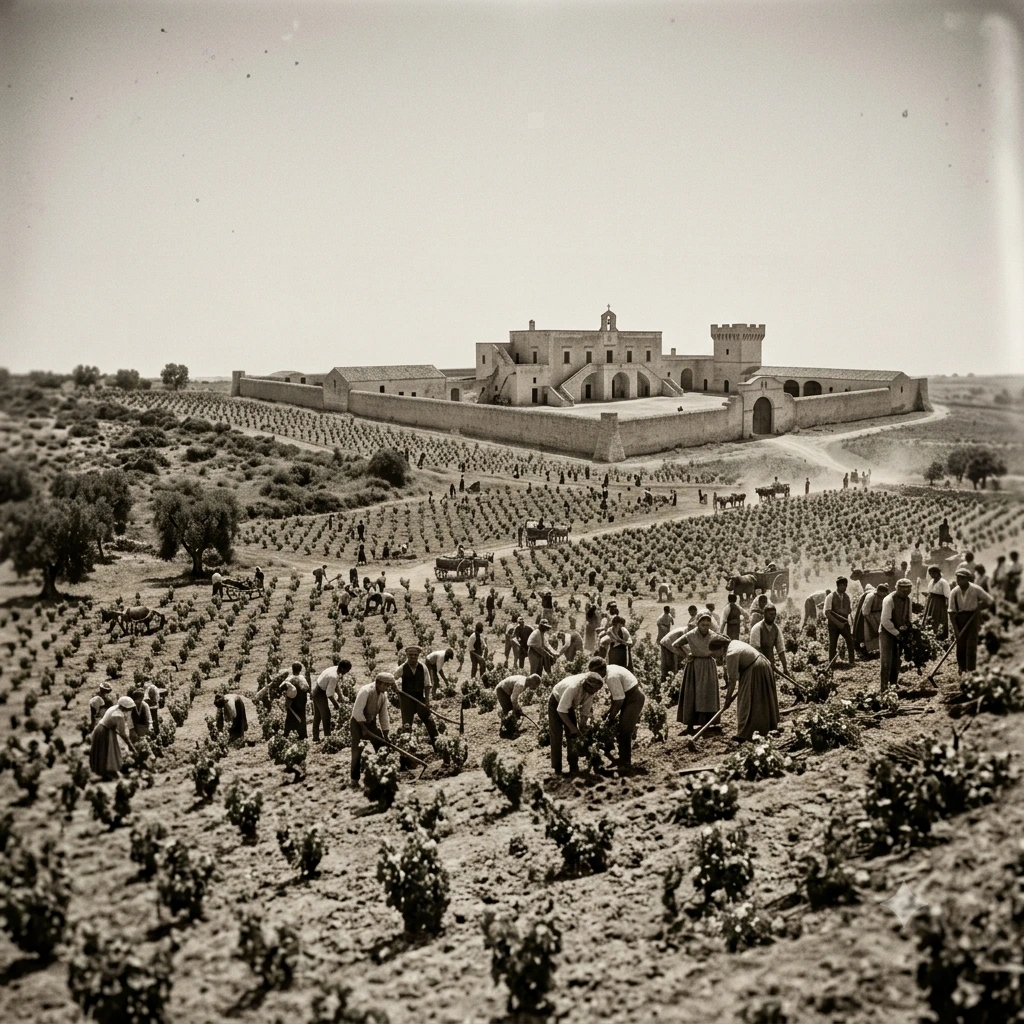
It all begins, paradoxically, far from Salento: in France, where around 1863 phylloxera arrived—hidden in the roots of American vine cuttings imported merely for botanical curiosity. This microscopic aphid feeds on vine roots. Within a few years, it devastated the French vineyards: France, which produced almost 85 million hectoliters of wine in 1875, produced a mere 23 million in 1889. A total collapse.
And here comes the stroke of luck—if it can be called that—for Salento. While France was burning its infected vineyards, Puglia, and with it the historical Terra d'Otranto, remained completely immune. Not due to a momentary "delay" in the contagion, as is often mistakenly written: phylloxera would only reach Puglia in 1899, thirty years later. Throughout the 19th century, Salento was simply one of the few lands in Europe where vines still grew healthy.
To this was added a stroke of diplomatic luck: in January 1863, Italy had signed a commercial treaty with France that lowered customs duties. The result was explosive. Pugliese wines—robust, dark, and loaded with sugar and high alcohol content—suddenly became highly prized commodities. Not to be drunk as they were (they were too rough and too strong), but to be mixed ("cut" or blended, hence the Italian term vino da taglio) with the weaker, more acidic wines of Northern Italy and France itself, to give them body, color, and strength.
The Vine Fever: Peasants Becoming Winemakers Out of Necessity
In Salento, the news spread quickly: there was a line to buy wine, at any price. And the peasants did what peasants have always done when a new market opens: they adapted, quickly and without much fuss.
The numbers tell the story of a true race to the vineyard. In Sava, in the heart of what we now call the Taranto Salento, the surface area cultivated with vines went from 245 hectares in 1816 to a whopping 1,280 hectares in 1878: more than five times as much. In Manduria, the increase was more contained but still significant, almost tripling. Lands that until recently were olive groves, almond orchards, or simple scrubland were cleared and planted with vines, because wine, at that moment, yielded more than anything else.
But behind these numbers lies a much less reassuring reality. We are not talking about entrepreneurs investing with foresight. We are talking about peasant families who, often in conditions of sharecropping or as indebted small landowners, threw themselves into a crop that promised quick money but also required grueling, seasonal physical labor. This work was unpaid until the harvest was in, leaving them entirely at the mercy of prices decided by others, very far away.
The Palmento: Where Wine Was Truly Born
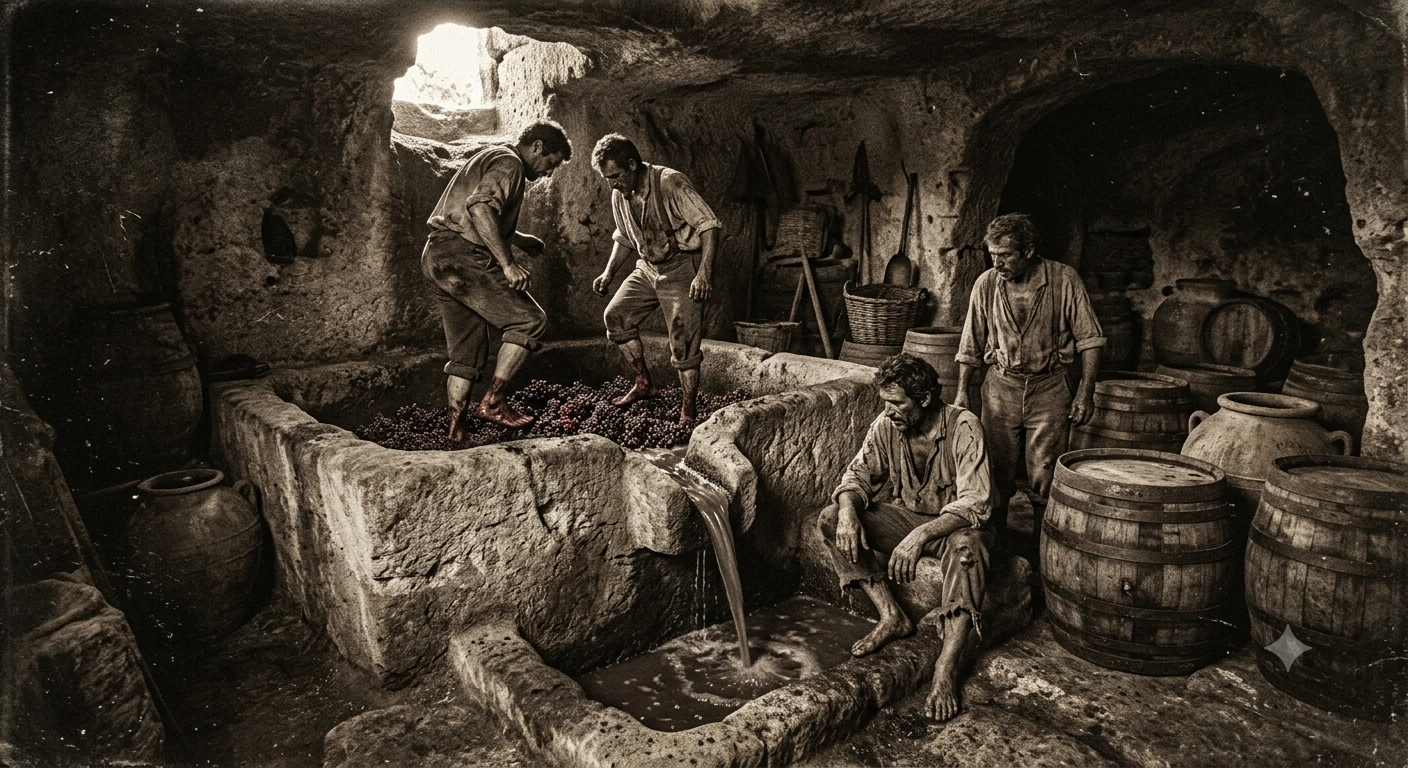
To understand the life of those who produced that wine, one must step into a palmento. Not a winery as we understand it today, but a rudimentary structure—often literally carved into the local calcarenite rock, using a technique in Salento dating back to the Byzantine era—made of communicating vats. They can still be found today, for example, in the countryside around Carpignano Salentino.
The work was entirely manual. Grape clusters were crushed barefoot in the upper vat; the must flowed by gravity into a lower vat, called the "masca," where it fermented spontaneously thanks to the natural yeasts present on the skins; finally, the wine was transferred into terracotta jars or wooden barrels. Every Salento town had several palmenti, often owned by different families, and the harvest was a collective moment—a mix of popular festival and exhausting toil, involving men, women, and children for weeks.
The large concrete vats that we now habitually associate with Salento's winemaking tradition did not actually exist yet in that era. They would only arrive late in the 20th century, and en masse only after the Second World War, with the birth of cooperative wineries (in Leverano, for instance, the cooperative was founded in 1959 and bought its first concrete vats only in 1964). In the 19th century, Salento wine was still born, almost everywhere, between rock and wood.
Carts, Oxen, and Dirt Roads: The Longest Journey of Wine
Here is a detail rarely told, but which says a lot about the hardship of those years: for much of the 19th century, the wine produced in the towns of the Salento hinterland—Salice Salentino, Veglie, Guagnano, Novoli, Copertino—had no nearby railway station. The great Adriatic railway line reached Lecce in January 1866, and shortly after, the stations of Squinzano, Trepuzzi, and San Pietro Vernotico were opened: lucky towns, connected immediately to the national network. But the inland towns—precisely those we now take for granted as the heart of Negroamaro—had to wait until 1907 to get their own railway.
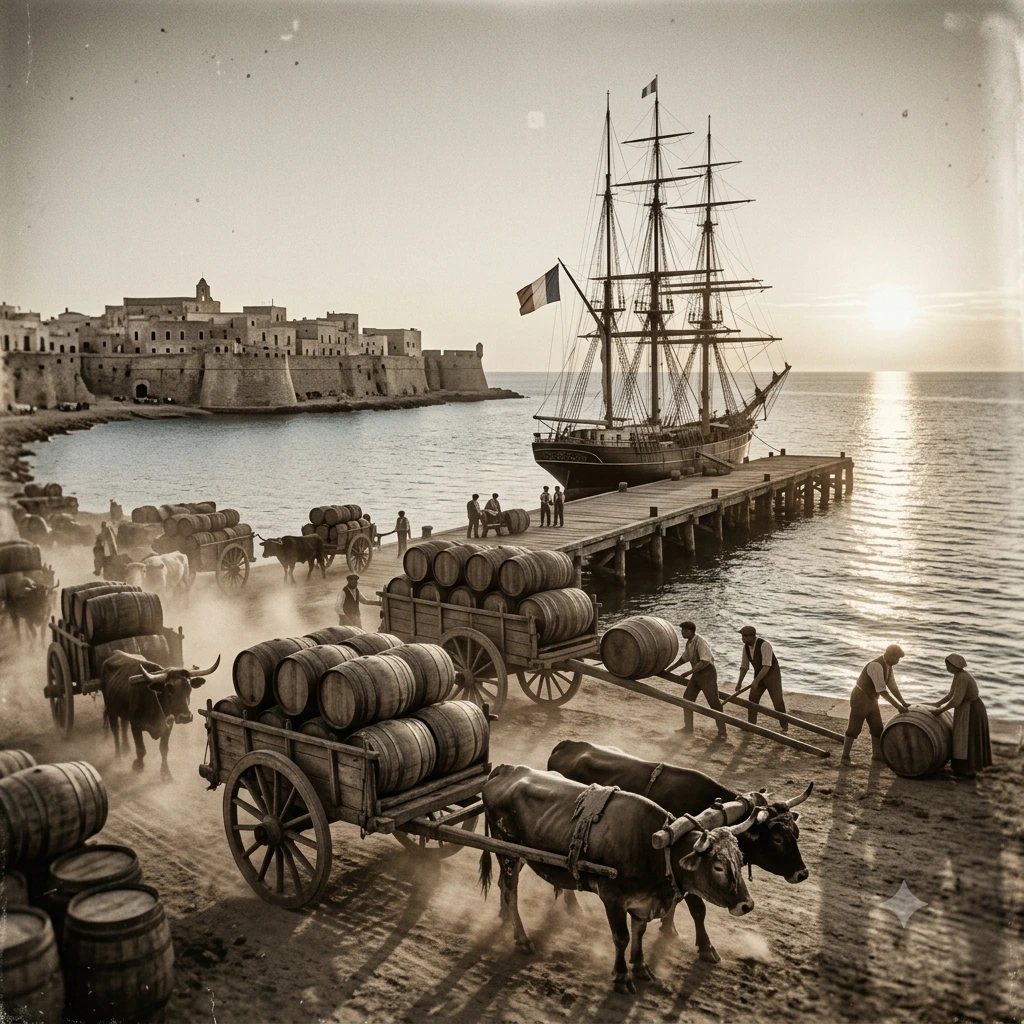
This means something very concrete: for forty years, during the peak boom of blending wine, barrels had to be loaded onto carts pulled by oxen or horses and transported along farm roads often reduced to simple dirt paths, all the way to the nearest station or directly to the port of Gallipoli. It was a slow, exhausting journey, dependent on the weather and the endurance of the animals—long before the wine could even begin its true journey to France.
The Collapse: When the Market Disappeared Overnight
Then, suddenly, everything stopped. In December 1886, Italy denounced the commercial treaty with France. In February 1888, a veritable customs war broke out, with duties on both sides skyrocketing. The result was an almost total closure of the French market: if until 1887 France absorbed about 41% of Italian wine exports, between 1888 and 1890 that share plummeted to 18%.
To understand what this meant in the Salento countryside, one must imagine entire families who, after years of investing in new vineyards, found themselves overnight without buyers. The wine, which until recently had sold for its weight in gold, no longer had an outlet. The year 1889 saw protests by laborers and small landowners reduced to misery throughout Puglia. Many, no longer knowing to whom to sell their blending wine, were forced to uproot the vines and convert the land to tobacco, just to survive.
It is a chapter of social history, even before it is an enological one: the very vulnerability that had allowed Salento peasants to enrich themselves rapidly in the 1860s and 1870s left them completely exposed when political decisions, made in Rome and Paris, turned off the tap.
Manduria, France, and a Myth to Be Told Honestly
It is precisely in these turbulent years, and not before, that one of the most beloved tales among Salento wine enthusiasts was consolidated: that of Primitivo di Manduria as the "wine of the French," born—according to legend—to replace the vineyards of the Roussillon destroyed by phylloxera.
The reality, reconstructed with closer attention to dates, is slightly different and perhaps even more interesting. Primitivo, first selected in Gioia del Colle in 1799, arrived in Manduria only thanks to a noble marriage: that between the young countess Sabini of Altamura and the Mandurian nobleman Tommaso Schiavoni-Tafuri. The most detailed sources place the bottling of the first "Primitivo di Campo Marino" in 1891—that is, three years after the closure of the French market. The Primitivo di Manduria as we understand it today, therefore, was born not in the golden age of trade with France, but in the subsequent phase: the desperate search for new markets.
Bouncing Back, Looking East
And indeed, it was toward Austria-Hungary, Germany, and Switzerland that Salento—like all of Puglia—turned after 1888, thanks to new commercial treaties signed between 1892 and 1895. The port of Gallipoli, with its commercial tradition already consolidated over centuries, continued to ship blending wine, this time toward Trieste and the Central European markets, right up until the First World War.
The Salento of blending wine, in short, was never a uniform system. It was a two-speed region, with a coastal strip connected early to the great European commercial flows, and a hinterland that for decades continued to rely on rock-hewn palmenti, animal-drawn carts, and dirt roads. A contrast that today, walking among the vineyards of Salice Salentino or Manduria, is difficult to even imagine—but which wrote, dripping laboriously from a palmento to a cart and from a cart to a ship, the very first page of the enological history of this land.
Dr. Stefano's Tip: Today, in the restored palmenti of Carpignano Salentino and in the historic wineries of Salice Salentino, you can still see the ancient pressing vats. Ask to visit them during a tour—it's the most authentic way to touch Salento's wine history with your own hands.
The History of Blending Wine in Salento
Main sources: F. Dandolo, "Viticoltura e produzione vinicola in Italia nel Mezzogiorno d'Italia in età liberale", Territoires du vin, 2014; Enciclopedia Treccani, entries "Fillossera" and "Gallipoli"; G. Ludovico, "Il territorio e Sava"; Wikipedia archives on Salento railway lines; Cantina Vecchia Torre di Leverano.
Wine Tour & History
Discover the ancient palmenti, historic wineries, and century-old vineyards of Salento. A unique experience blending history, culture, and the finest wines of Puglia.
BOOK YOUR TOUR